
What Is DCR? State of Hawaii Department of Corrections and Rehabilitation
DCR is Hawaii's current statewide correctional agency. The agency home page identifies the State of Hawaii Department of Corrections and Rehabilitation and uses the abbreviation DCR in its mission statement. The former Public Safety branding matters only as historical context: effective January 1, 2024, the former Department of Public Safety was redesignated as DCR, while law-enforcement functions moved to the Department of Law Enforcement.
The DCR home page is the official agency source for the department name, DCR abbreviation, mission, and statewide correctional framing.
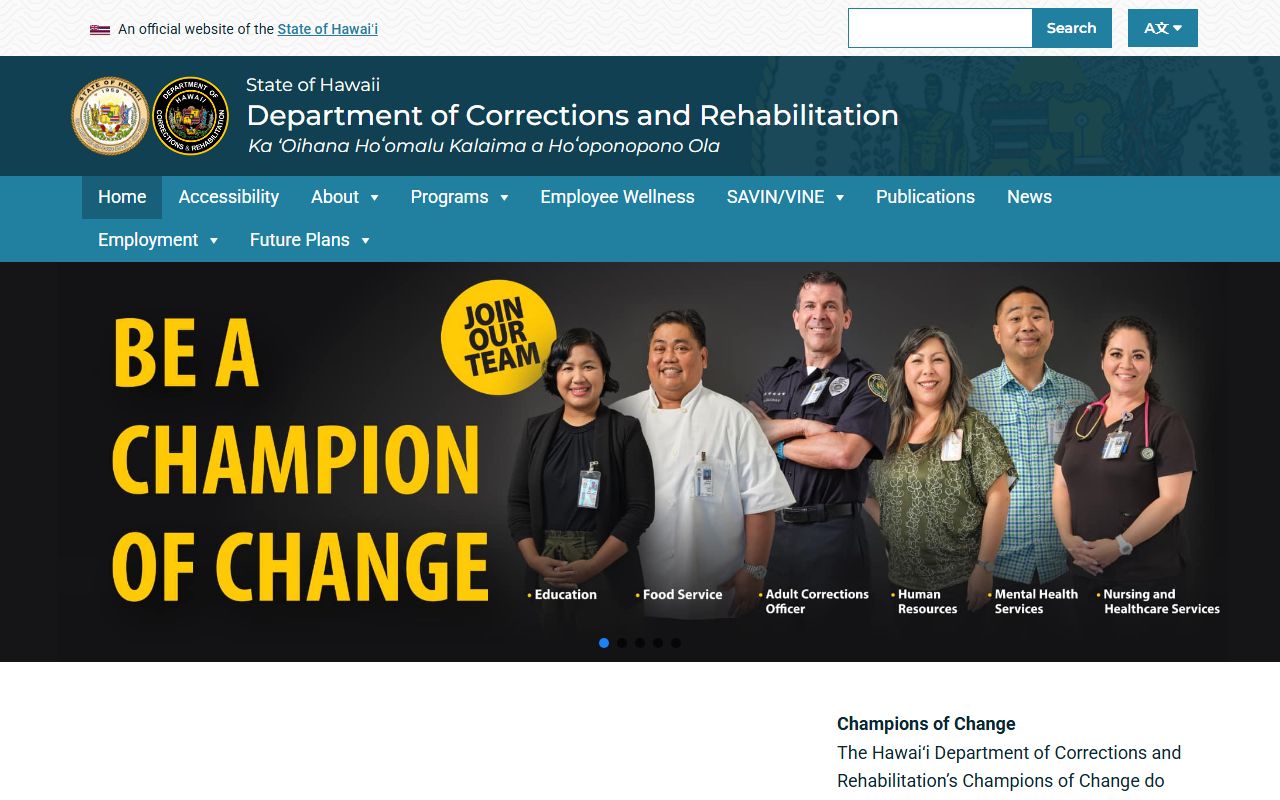
That official agency identity is why the DOC page uses DCR in the URL, title, headings, and body copy.
DCR is the proper anchor for the DCR inmate population because Hawaii is a unified correctional jurisdiction. DCR oversees four jails, four in-state prisons, and the mainland facility category used for Hawaii inmates. County subdomains help with local routing, but the main jail-equivalent institutions are DCR community correctional centers rather than sheriff-run county jails.
That distinction affects search results. A person arrested in Hilo, Honolulu, Lihue, or Wailuku may begin in a police-stage booking channel, move into a DCR community correctional center if custody continues, appear in eCourt Kokua after a case is filed, and later move to a state prison or mainland DCR placement if sentenced. The DCR inmate population page therefore treats DCR as the correctional hub while still separating police logs, court records, federal custody, and ICE custody from DCR records.
The DCR Inmate Population
DCR's March 31, 2026 population report listed 2,841 in-facility head count in Hawaii jails and prisons, plus 3,693 total assigned count when mainland and contracted placements were included. The same report listed 794 Hawaii inmates in the mainland contracted facility category, including Saguaro Correctional Center in Arizona, and one assigned/head-counted at Federal Detention Center.
The DCR Correctional Institutions Division page lists the jails, prisons, Saguaro placement context, and population-report entry points used for the DCR inmate population discussion.
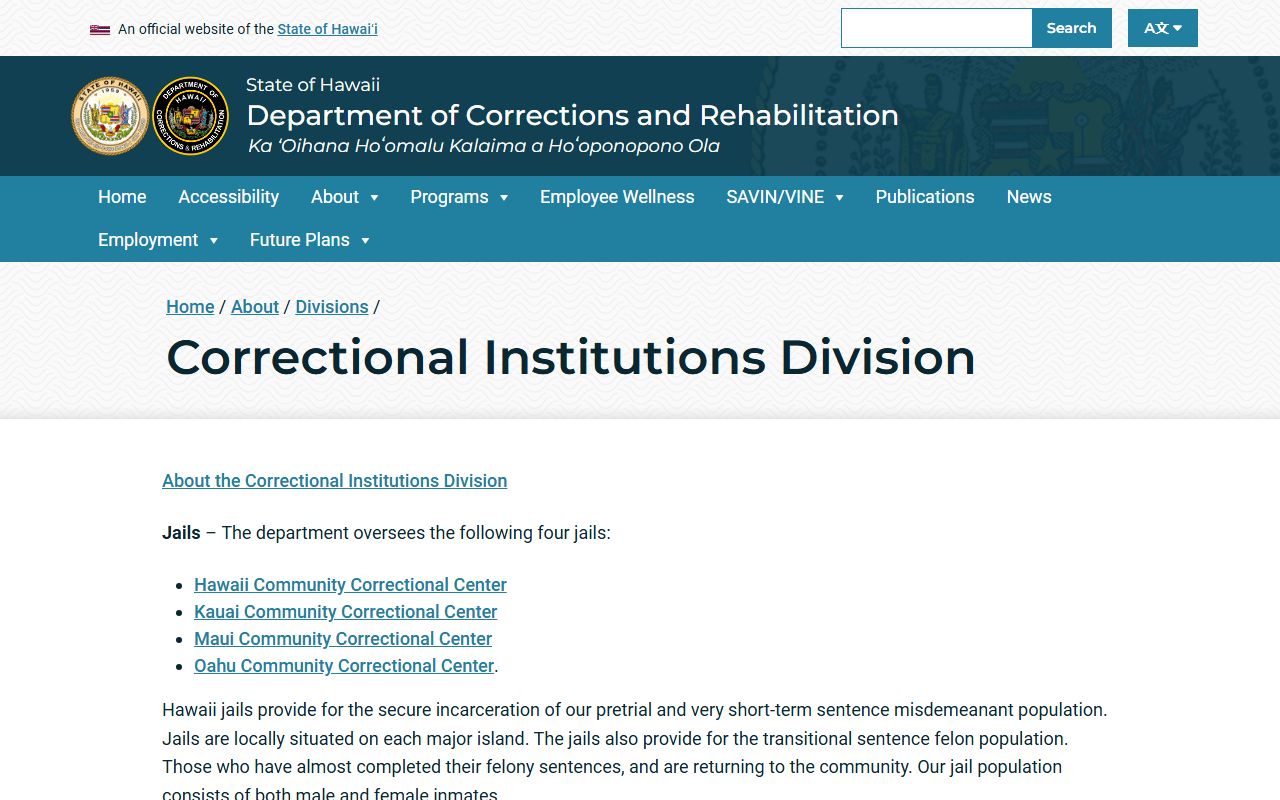
The institution list is the bridge between the DCR population count and the facilities where those custody categories are held.
| Measure | Figure | Source / Date |
|---|---|---|
| DCR inmate population, in-facility head count | 2,841 | DCR report, March 31, 2026 |
| DCR assigned count including mainland/contracted placements | 3,693 | DCR report, March 31, 2026 |
| In-state community correctional centers | 4 | DCR Correctional Institutions Division |
| In-state prisons | 4 | DCR Correctional Institutions Division |
| Mainland contracted category | 794 | DCR report, March 31, 2026 |
The DCR inmate population count has two layers. The Hawaii facility head count is a physical count inside the state facilities listed in the population report. The assigned count is broader because it includes people still assigned to DCR through contracted or mainland custody. That is why Saguaro Correctional Center appears in the DCR population discussion even though it is not in a Hawaii county folder. The research also notes one assigned/head-counted person in the Federal Detention Center category in the March 31, 2026 DCR report.
| Facility or Category | Head Count | Assigned Count | Operational Capacity |
|---|---|---|---|
| Hawaii Community Correctional Center | 295 | 307 | 226 |
| Halawa Medium Security Facility | 826 | 833 | 992 |
| Kauai Community Correctional Center | 92 | 98 | 128 |
| Kulani Correctional Facility | 77 | 77 | 200 |
| Maui Community Correctional Center | 212 | 218 | 301 |
| Oahu Community Correctional Center | 898 | 905 | 954 |
| Women's Community Correctional Center | 288 | 308 | 260 |
| Waiawa Correctional Facility | 153 | 153 | 334 |
| Mainland / Saguaro category | 794 | 794 | Not in Hawaii bed table |
How to Search the DCR Inmate Locator
The official public DCR-linked locator is Hawaii SAVIN / VINELink. DCR describes Hawaii SAVIN as the Statewide Automated Victim Information and Notification service, powered by VINE, for custody and parole status of offenders under DCR jurisdiction. It is a DCR custody/parole notification route, not a full criminal-history database or mugshot archive.
The DCR SAVIN page explains the statewide notification service and the custody/parole status role it serves.
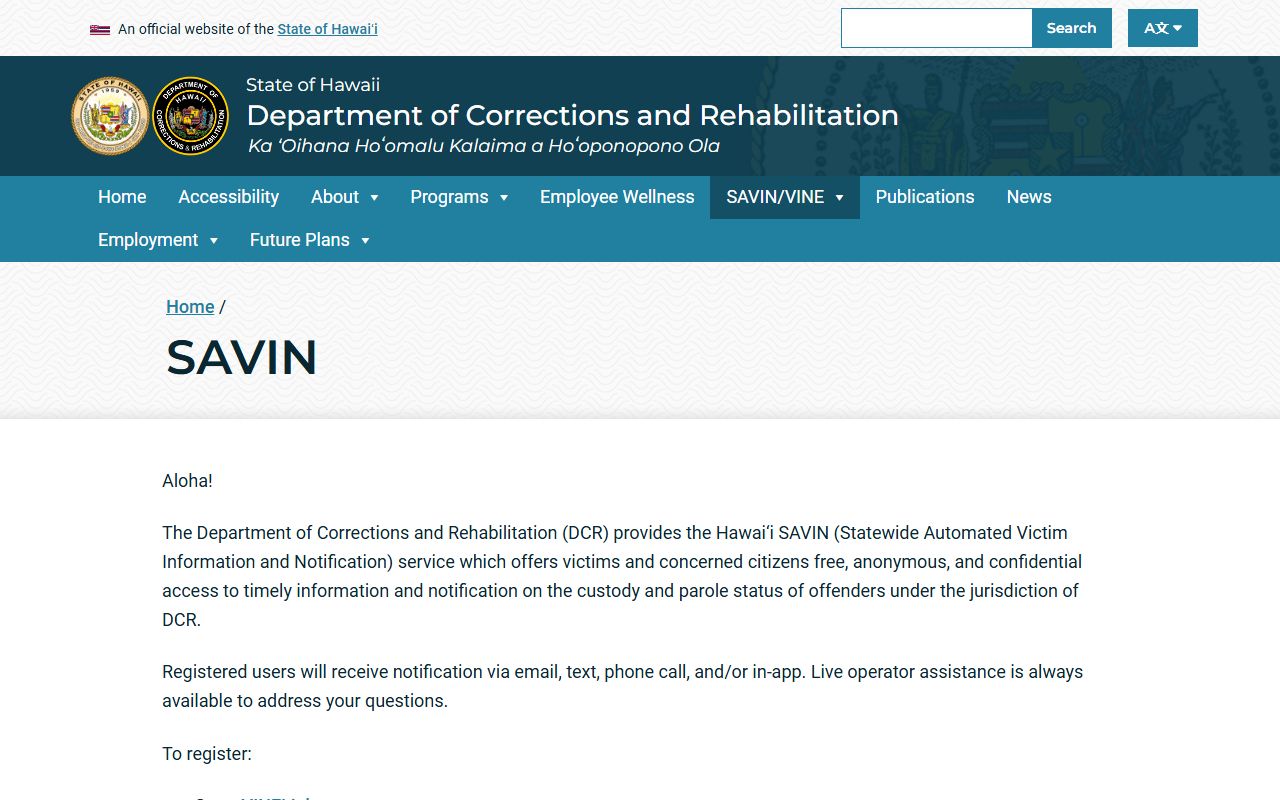
SAVIN explains the notification side; the person-search portal is the lookup side used by the public.
The Hawaii VINELink person-search page is the direct DCR-linked search interface captured for this build.
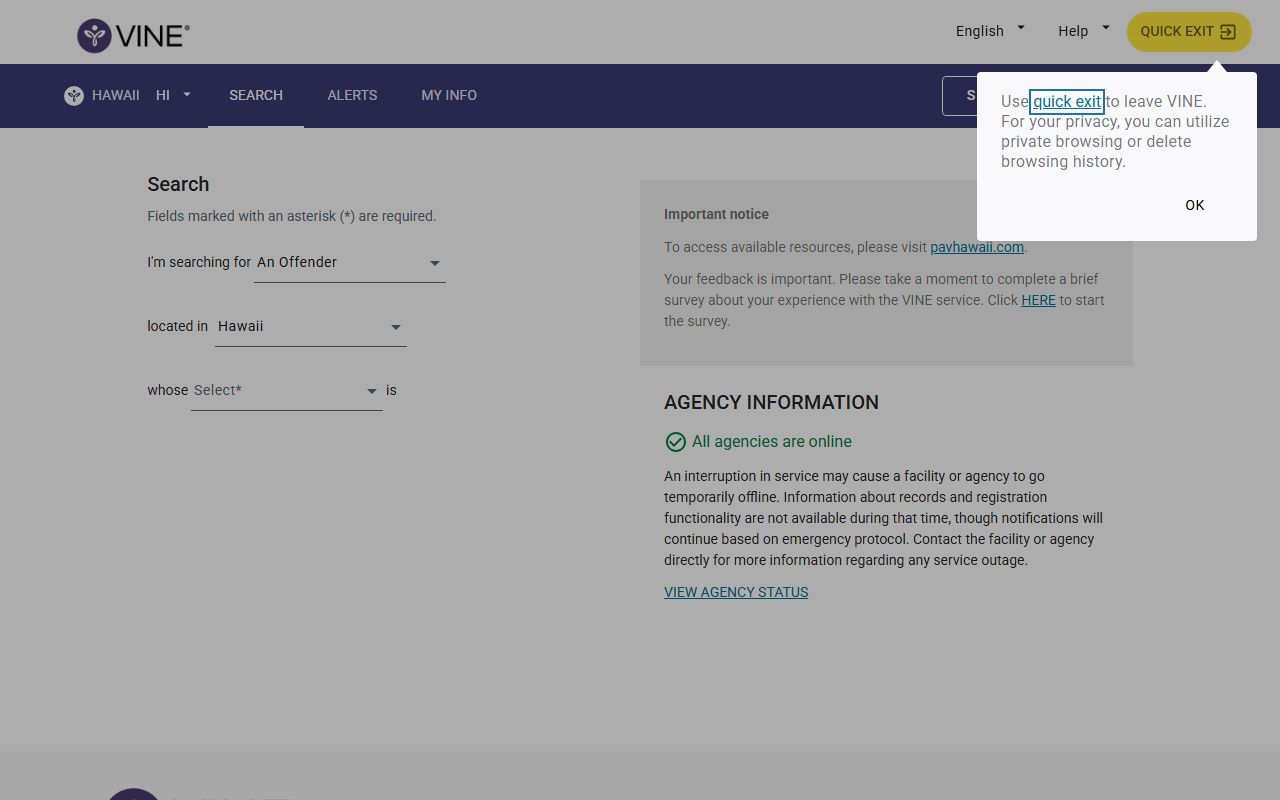
The result should be treated as a DCR custody or parole-status lead, not as a complete court, police, or federal record.
- Open the Hawaii VINELink person-search portal or start from DCR's SAVIN page.
- Search for the person using the available identity details in the VINELink interface.
- Use the result as a DCR custody or parole-status signal and confirm urgent details with the facility or agency.
- Register for notifications if custody or parole status changes matter; DCR lists web, phone, mobile app, and TTY registration channels.
- If there is no DCR result, check whether the person is still in police cellblock custody, a federal BOP case, ICE custody, or only a court-record question.
| Search Need | Use DCR/SAVIN? | Use Another System? |
|---|---|---|
| DCR community correctional center custody | Yes, when the person is under DCR jurisdiction | Facility contact can confirm urgent details |
| State prison or parole status | Yes | DCR facility or parole channels may be needed for details |
| Police cellblock before court | No, not until DCR applies | Local police booking or cellblock route |
| Formal charges after filing | No, DCR does not replace court records | eCourt Kokua and courthouse records |
| Federal or immigration detention | No | BOP, U.S. Marshals, federal court, or ICE ODLS |
Expected result fields should be described with care. The research does not verify that Hawaii VINELink displays booking photos, a full sentence calculation, housing unit, bond amount, or complete charge lists for every person. The reliable statewide wording is narrower: use Hawaii SAVIN/VINELink to check DCR custody or parole status and to register for custody-status notifications. Use court, police, BOP, or ICE systems for records outside DCR.
DCR Prisons and Facilities
DCR's jail list is Hawaii Community Correctional Center, Kauai Community Correctional Center, Maui Community Correctional Center, and Oahu Community Correctional Center. DCR says Hawaii jails hold pretrial detainees and very short-term sentenced misdemeanants, and can also hold transitional sentenced felons close to returning to the community. The prison list is Halawa Correctional Facility, Waiawa Correctional Facility, Kulani Correctional Facility, and Women's Community Correctional Center.
The Halawa Correctional Facility page documents the maximum, closed, special-needs, and medium-security prison context within DCR.
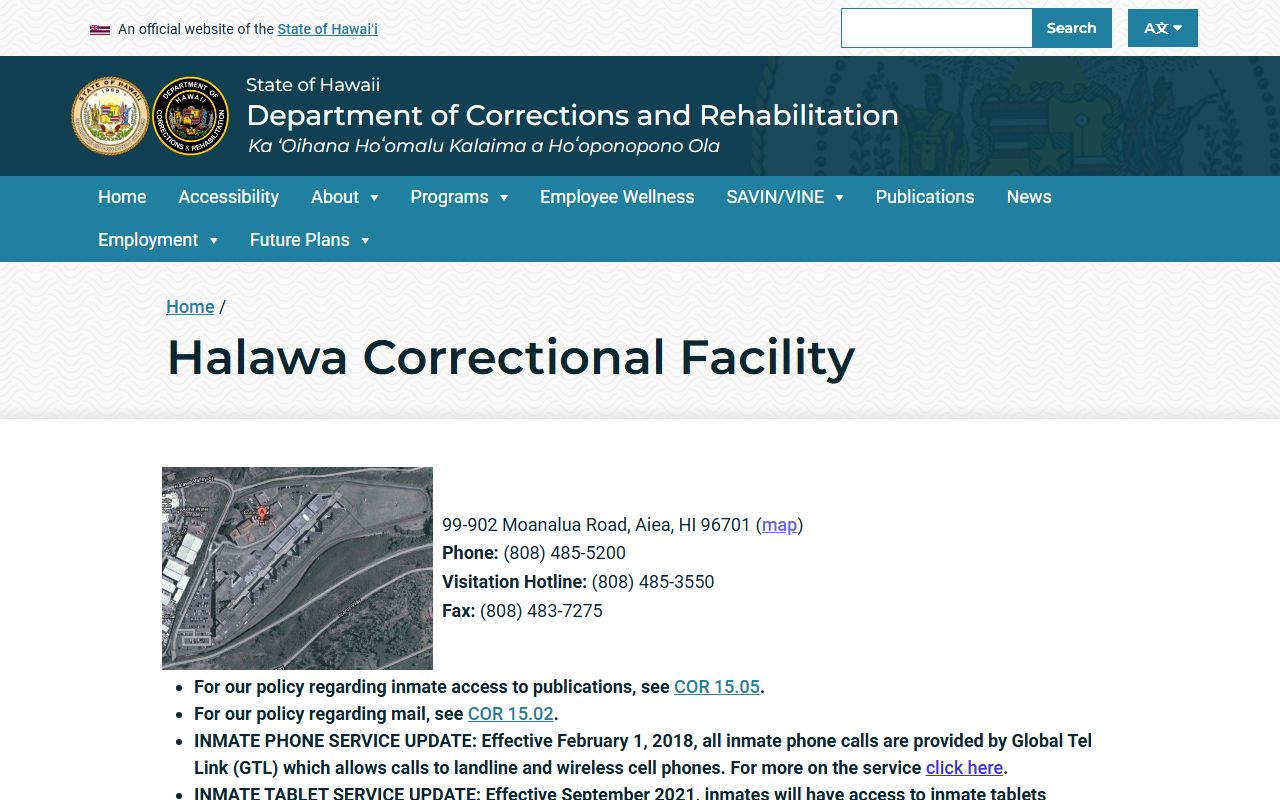
Halawa is one reason the DCR page separates sentenced prison custody from community correctional center custody.
Halawa includes medium-security and special-needs components. Waiawa is a minimum-security male prison with reentry and treatment programming. Kulani is a minimum-security Big Island prison. WCCC is Hawaii's only women's prison and houses maximum, medium, and minimum custody levels, including pretrial and sentenced female custody. Browse the Facility Directory for the complete statewide roll-up.
Community correctional centers are different from prisons. Hawaii Community Correctional Center serves Hawaii Island and includes the Hale Nani reintegration program site in Panaewa. Kauai Community Correctional Center is the Kauai DCR jail-equivalent facility. Maui Community Correctional Center serves Maui-area jail custody and reintegration functions. Oahu Community Correctional Center is the largest Hawaii jail facility and manages Laumaka Work Furlough Center nearby. These facilities can hold pretrial detainees, short-term sentenced custody, sentenced felons in transition, parole or probation holds, and other statuses that do not fit a single prison-search label.
The Waiawa Correctional Facility page shows how DCR describes a minimum-security male prison with reentry and substance-abuse treatment programming.
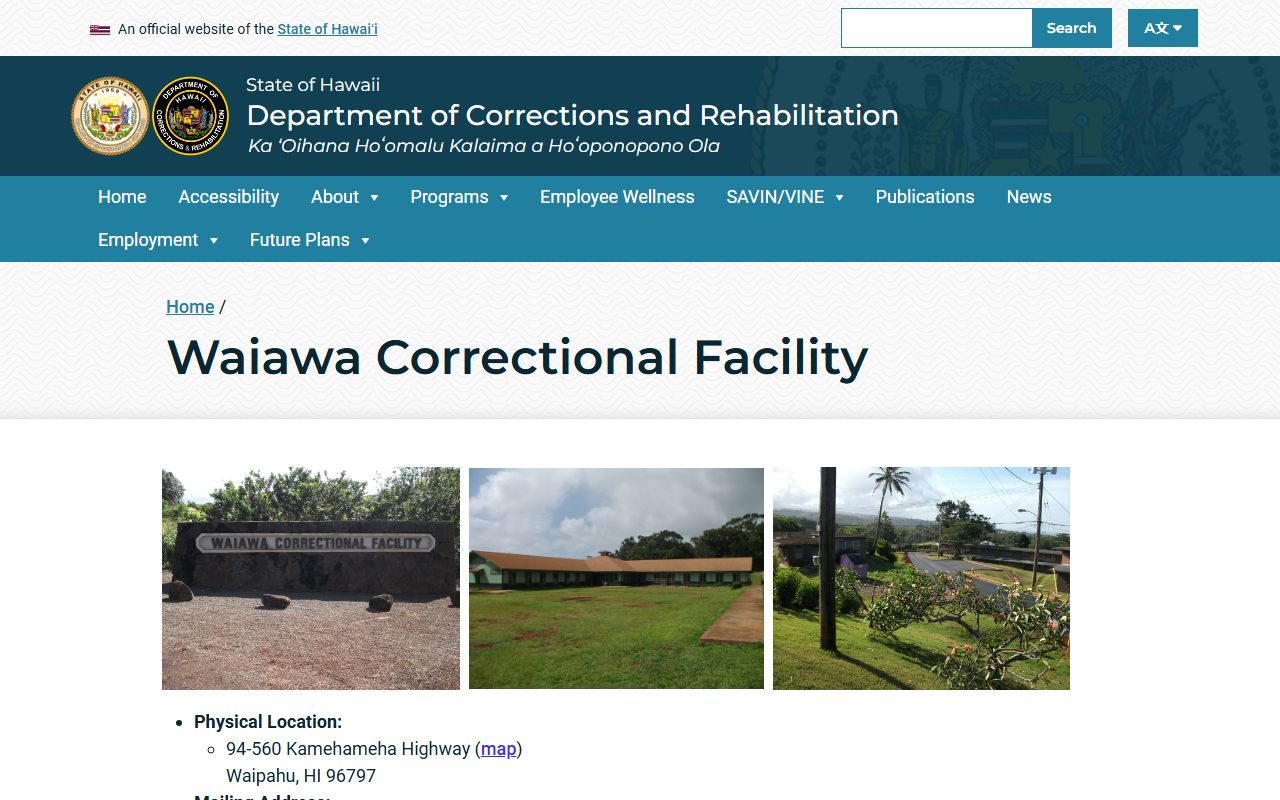
Waiawa helps illustrate why DCR custody is not just a live jail roster; it includes sentenced prison placement and reentry programming.
DCR Inmate Population Trends
The recent DCR inmate population trend in the research is a slight decline over two months. January 31, 2026 showed 2,862 in-facility head count and 3,719 assigned count. March 31, 2026 showed 2,841 in-facility head count and 3,693 assigned count.
| Date | Head Count | Assigned Count |
|---|---|---|
| January 31, 2026 | 2,862 | 3,719 |
| March 31, 2026 | 2,841 | 3,693 |
The two-month decline was 21 in-facility head count and 26 assigned count. That does not mean every facility declined. The March table shows different head counts by institution, with OCCC, Halawa Medium Security Facility, WCCC, HCCC, MCCC, Waiawa, KCCC, and Kulani each carrying different custody roles. A DCR inmate population search should therefore avoid using one statewide number as proof that a person is in a particular building.
Sentencing, Parole, and Release in DCR Custody
Hawaii prison release timing is shaped by the Hawaii Paroling Authority. HRS 706-669 requires a minimum-term hearing for people sentenced to indeterminate or extended terms, with notice, opportunity to be heard, counsel, victim and prosecutor participation, and public guidelines. HRS 706-670 governs parole hearings, risk assessment, release procedure, parole plans, denial intervals, and maximum-term release. HRS 353-66 governs parole conditions, suspension, revocation, and credits or forfeiture issues.
The research does not support a simple universal good-time formula for every DCR prisoner. Release timing depends on the court's maximum sentence, the Hawaii Paroling Authority's minimum-term order, parole hearings, risk assessment, approved parole plan, institutional conduct, statutory exclusions, and any applicable credits or forfeitures.
- Minimum term
- The period fixed by the Hawaii Paroling Authority before parole eligibility for many indeterminate or extended sentences.
- Parole plan
- The release plan described in HRS 706-670, including where the person will live and intended work or occupation when applicable.
- Revocation
- A process that can return a parolee to custody after notice and hearing requirements, subject to statutory limits and conditions.
- Maximum term
- The outer sentence limit set by the court; release timing may still depend on parole decisions and statutory rules.
Jail release is a different question. People in DCR community correctional centers may be pretrial detainees, short-term sentenced misdemeanants, parole violators, probation holds, or transitional sentenced felons. Bail, release conditions, and first-appearance timing are court-driven, while DCR/SAVIN is a custody-status and notification route. That is why the DCR inmate locator should not be treated as a bond calculator, a court calendar, or a complete sentencing record.
DCR Records Requests
For DCR custody, population, facility, program, policy, or institution records, route the request to DCR as the maintaining agency. Hawaii's OIP says a requester should send a written request directly to the state or county agency likely to hold the record, identify the record, include contact information, and state whether inspection or copies are requested. Agencies generally have 10 business days to grant, deny, or acknowledge a request, with additional time possible in extenuating circumstances.
UIPA does not make every inmate-file detail public. HRS 92F-13 includes exceptions for privacy, confidential records, records protected by law or court order, and records whose disclosure would frustrate a legitimate government function.
Use the agency that keeps the record. DCR is the route for DCR population reports, institution records, facility policies, custody records, and DCR program records. A county police department is the route for police booking logs, arrest reports, and police incident records. The Hawaii Judiciary is the route for filed cases and certified court records. Federal FOIA, not Hawaii UIPA, controls federal records held by BOP, ICE, U.S. Marshals, or federal courts.
Note: A DCR records request is not a fast substitute for live custody confirmation when release, safety, or visitation timing is urgent.
DCR Inmate Population FAQ
What is the official DCR inmate locator?
Hawaii SAVIN/VINELink is the DCR-linked public search and notification channel for custody and parole status under DCR jurisdiction.
Does DCR cover county jail custody?
In Hawaii, the main jail-equivalent community correctional centers are run by DCR. Police cellblocks and arrest logs remain local police matters, and court records move through the Hawaii Judiciary.
Why does the DCR inmate population include Saguaro?
DCR identifies Saguaro Correctional Center in Arizona as the mainland facility housing Hawaii inmates, and its March 31, 2026 report listed 794 inmates in the mainland contracted category.