
Hawaii Court Records After Arrest Start After Booking
A Hawaii arrest can pass through several record systems before it looks like a court case. The first record may be a police booking or holding entry. Hawaii County research gives the clearest official example: Hawaii Police Department publishes 48-hour booking logs and says people may use Hilo or Kona cellblock routes for recent arrested-adult custody confirmation. That police-stage information is not the same as a statewide court docket, and the research cautions that VINELink does not apply to suspects held in a police cellblock before court processing.
If detention continues, the person may move into a Department of Corrections and Rehabilitation community correctional center such as OCCC, HCCC, KCCC, or MCCC. The practical path is arrest, booking, first court appearance or court processing, then a filed case record when the Judiciary has one. Use the Hawaii inmate records guide for custody status and this court-record route for what was filed after the arrest.
eCourt Kokua Court Records After Jail Arrest
The Hawaii Judiciary identifies eCourt Kokua as the statewide public route for court records. Its Search Court Records page says eCourt Kokua covers public case information from traffic cases, District Court and Circuit Court criminal cases, Family Adult Court criminal cases, civil case types, Land Court, Tax Appeal Court, and appellate cases. For an arrest-related search, the key point is the criminal case layer: eCourt Kokua helps after a filed case exists.
The Hawaii Judiciary Search Court Records page explains the statewide eCourt Kokua route and the continued role of certified paper records.
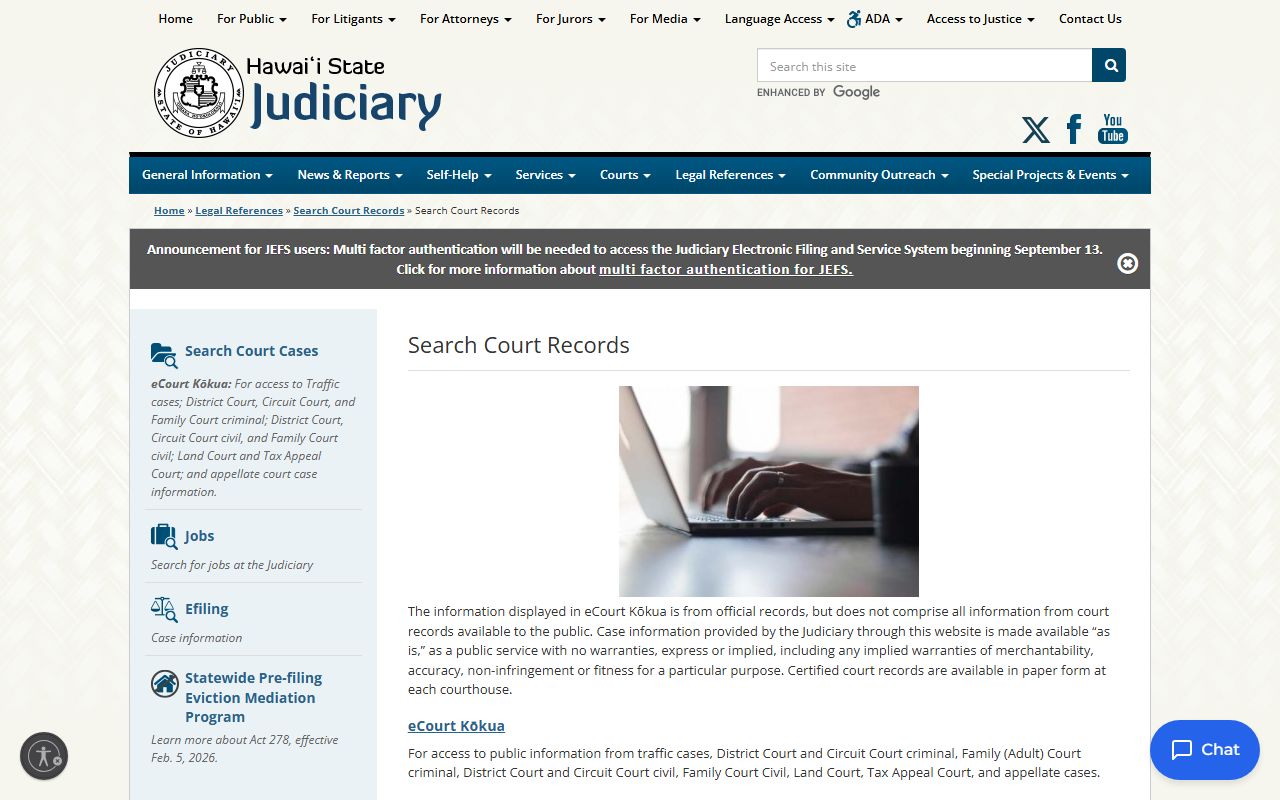
That Judiciary page is the source for treating eCourt Kokua as a filed-case system, not a live jail roster.
After a jail arrest, eCourt Kokua can help identify filed criminal cases, case status, events, bail or bond information where available, dockets, and formal offenses. It does not replace police booking logs for the earliest arrest stage.
| Stage | Record Question | Best Hawaii Source |
|---|---|---|
| Arrest and booking | Was the person recently booked or held by police? | Local police booking logs or cellblock routes where available |
| Continuing jail custody | Is the person in a DCR community correctional center? | Hawaii SAVIN/VINELink and DCR facility routing |
| First court activity | Has a criminal case been filed after the arrest? | eCourt Kokua after the case exists |
| Case follow-up | What are the events, status, dockets, and formal offenses? | eCourt Kokua, courthouse records, and certified paper copies |
Direct eCourt Kokua Portal for Filed Arrest Cases
The direct portal is the court-record starting point once the arrest has become a filed criminal case. For the first few hours or days, a person may be in police holding, DCR custody, released, or pending court processing. Once a case is filed, the court record can show information that a custody search cannot provide.
The direct eCourt Kokua portal is the statewide entry point captured for Hawaii filed case searches.
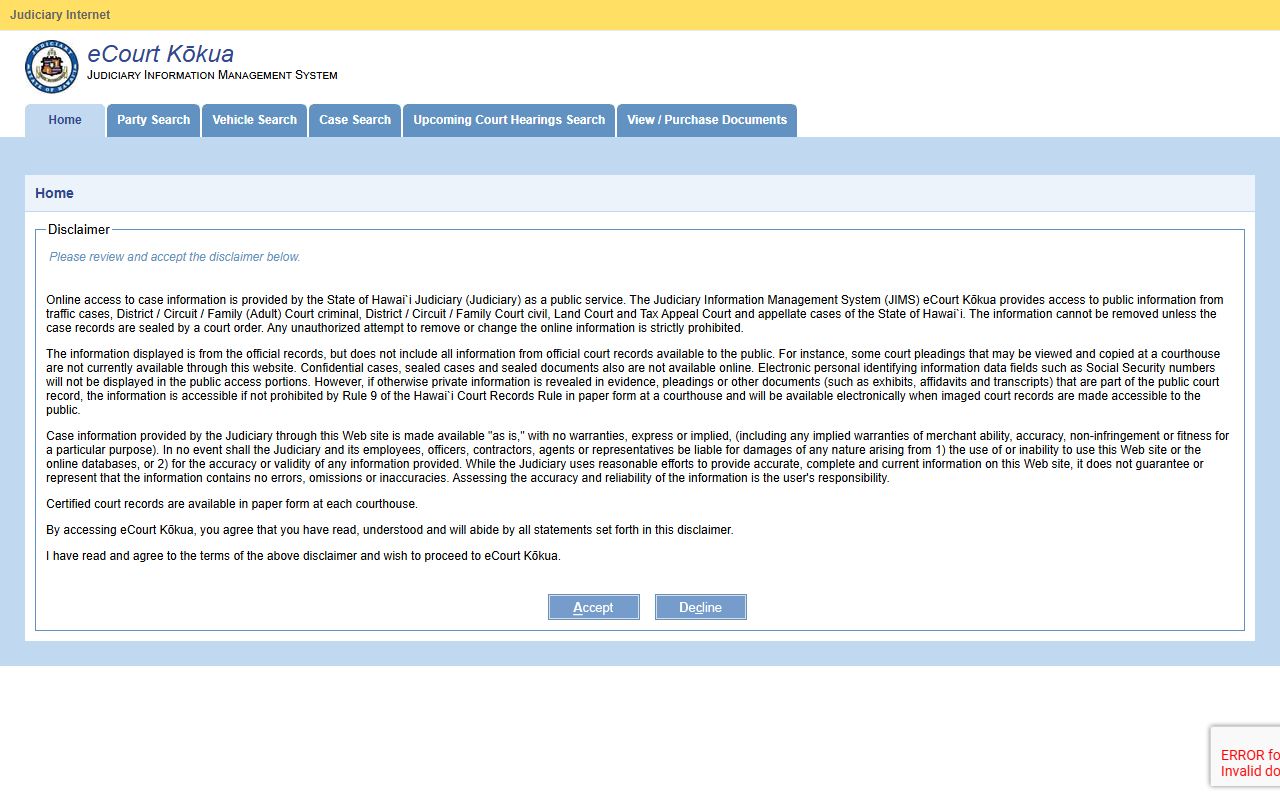
Use the direct portal when the question is a filed court case rather than whether a person is still in jail.
| Court Record Field | How to Read It After Arrest | Limit |
|---|---|---|
| Filed case | Signals that the arrest has a public court case path. | No filed case result does not prove no arrest occurred. |
| Formal offense | Shows the court-facing charge information supported in the research. | A charge is not the same as a conviction. |
| Case status | Helps place the case in the court process. | Status does not confirm current jail location. |
| Events and dockets | Show public court activity where available. | Not every public-record detail is online. |
| Bail or bond field | May explain release-related court information when present. | Verify current release or custody status with the official source. |
Charge vs. Conviction in Hawaii Court Records After Arrest
A filed charge is an allegation or formal offense in the court system. It is not a conviction. The court record can show that a case was filed and can show events or status, but the reader still has to distinguish accusations, pending cases, dismissed matters, amended charges, and convictions. The research supports describing eCourt Kokua as a filed-case source, not as a criminal-history report that resolves every legal outcome in one screen.
| Comparison | Meaning | Hawaii Search Note |
|---|---|---|
| Arrest | A police-stage event that may start with booking or holding. | Check local police routes or the relevant county page first for very recent events. |
| Charge | A formal offense or filed allegation appearing in the court path. | Use eCourt Kokua after the Judiciary has a filed case. |
| Case status | The court's current public status for the filed case. | Status helps track the case but does not equal custody status. |
| Conviction | A final outcome, when the court record supports that conclusion. | Do not call a charge a conviction without confirming the outcome in the court record. |
A booking photo, DCR custody result, and court record answer different questions. None should be stretched beyond what the official record actually says.
Charging Documents and Court Record Copies
The Judiciary's eCourt Kokua information page explains the document layer. Public documents may be available through PDF icons, but confidential cases and sealed documents are not available. Older documents may not be online. Hard copies may be requested from courthouse contacts. The research also notes eCourt Kokua costs: individual documents from 1 to 30 pages cost $3, additional pages cost 10 cents, and subscriptions cost $125 quarterly or $500 yearly. Certified court records remain paper records available at each courthouse.
The Judiciary eCourt Kokua information page is the source for case-type coverage, older-format limits, public document access, and fees.
Those access rules explain why a filed charge may be visible while a certified or older paper record still requires courthouse handling.
| Charging or Case Record Item | What It Can Answer | Where the Research Points |
|---|---|---|
| Filed criminal case | Whether the arrest has moved into a public court case. | eCourt Kokua direct portal and Judiciary court-records page |
| Formal offense | What charge information appears in the court-facing record. | eCourt Kokua after filing |
| Docket or event entry | What public court activity is recorded for the case. | eCourt Kokua, subject to availability limits |
| Public PDF document | Whether a public online document is available through the portal. | PDF icons where available, with stated fees |
| Certified paper record | Official certified court copy for use where certification matters. | Courthouse paper records, not a jail roster |
Sealed, Confidential, Public, and Expunged Records
Public does not mean complete. The Judiciary's eCourt Kokua information page says confidential cases and sealed documents are not available through the public portal. It also says older documents may not be online. Hawaii's Uniform Information Practices Act, or UIPA, supplies a separate public-record framework for government records held by state and county agencies. HRS 92F-13 includes exceptions for privacy, prosecution or defense records where not discoverable, confidential government-function records, records protected by law or court order, and certain legislative working materials.
The Office of Information Practices request page explains how to route a public-record request to the agency most likely to maintain the record.
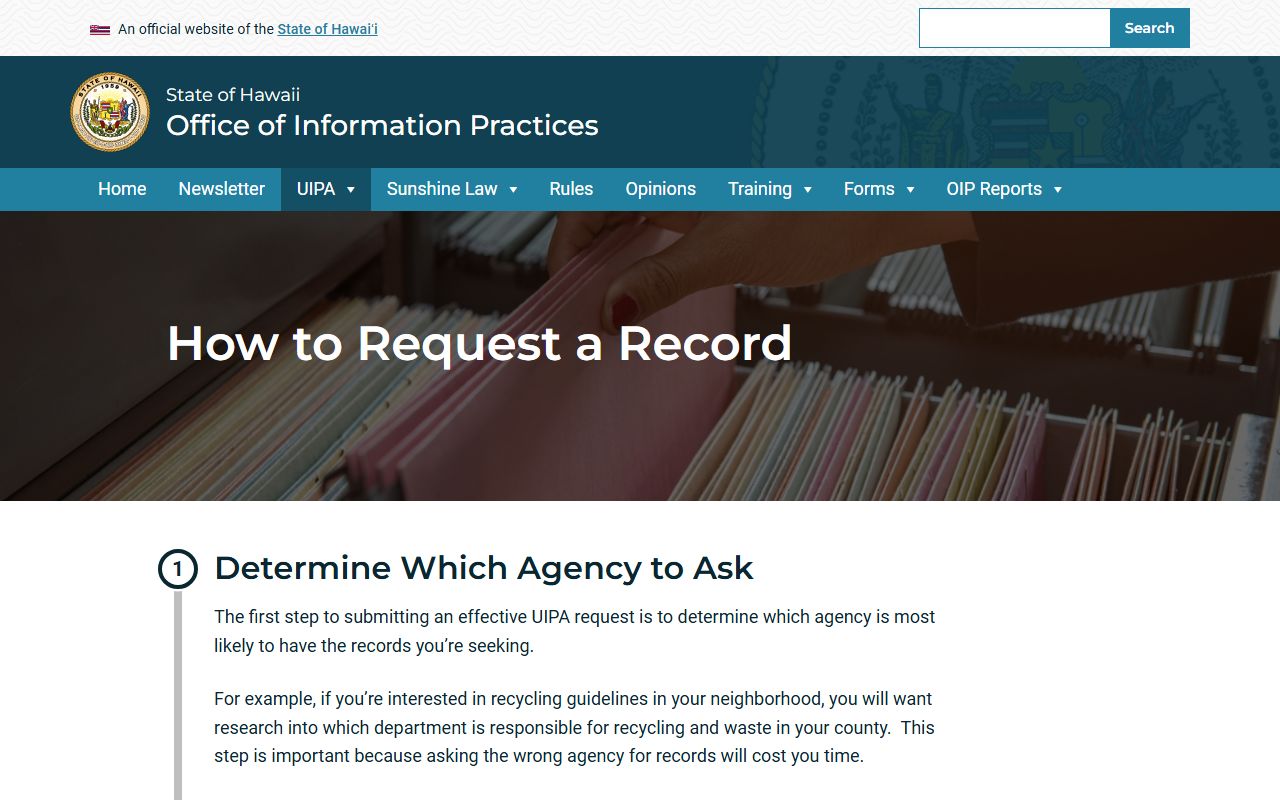
That process is useful when the record is maintained by DCR, police, a courthouse, or another agency rather than exposed through eCourt Kokua.
| Record Status | Public-Access Meaning | Search Caution |
|---|---|---|
| Public court information | May be searchable through eCourt Kokua when the case type and document are available. | Still may not include all public court-record information. |
| Sealed or confidential | Not available through public eCourt Kokua according to the Judiciary access page. | Do not assume the absence of a public document means no case exists. |
| Older document | May not be available online. | Use courthouse contacts or certified paper-record routes when supported. |
| Expunged or otherwise restricted | The research supports general access limits and court-order restrictions under UIPA, but does not provide a Hawaii expungement procedure in the source material. | Do not infer restricted details from missing public results. |
Custody Search vs. Court Records After Arrest
The most common error is using the right portal for the wrong question. Hawaii SAVIN/VINELink is the custody and parole-status route for offenders under DCR jurisdiction. It does not replace eCourt Kokua, and the research warns that VINELink does not apply to federal prison inmates or suspects held in a police cellblock before court processing.
The Hawaii VINELink person-search portal is the direct custody and parole-status search route for DCR jurisdiction.
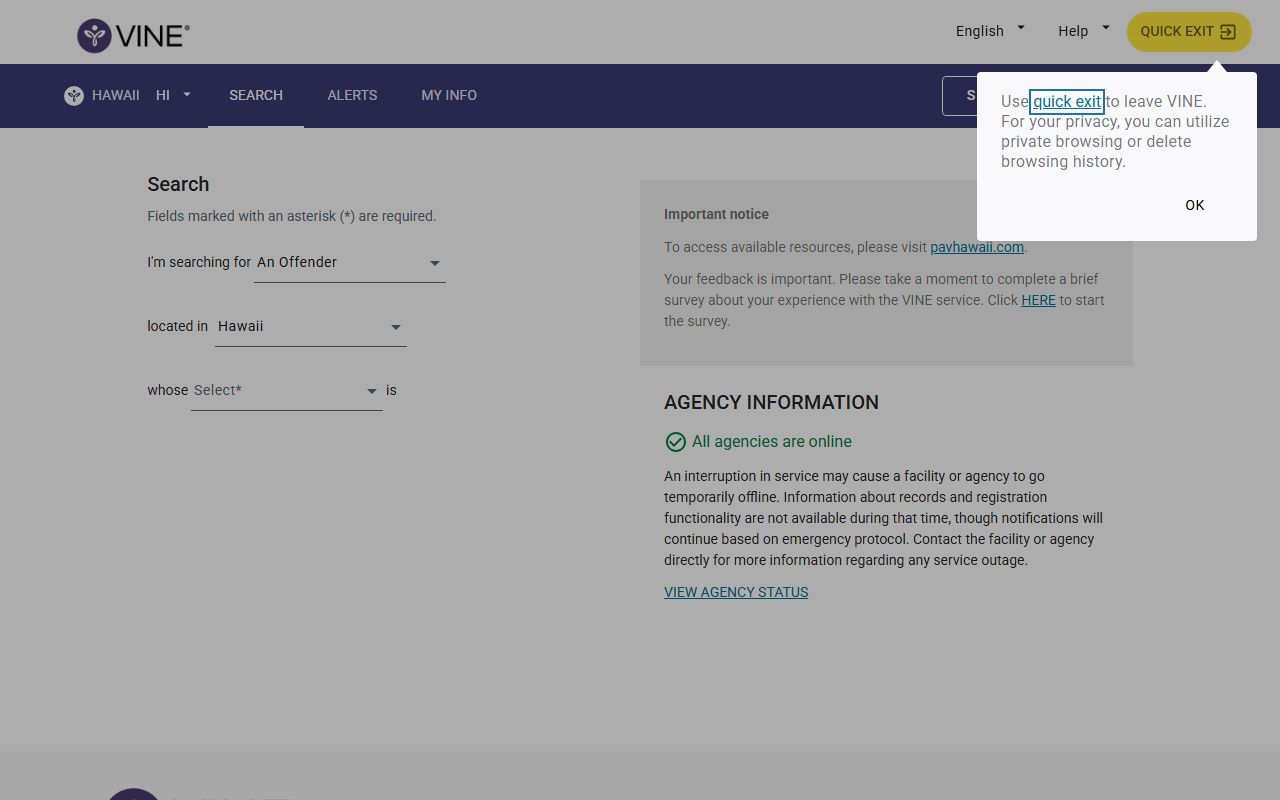
VINELink can answer a custody-status question, while eCourt Kokua answers the filed-case question.
Use Hawaii jail rosters and mugshots for roster and booking-photo limits. Use court records to understand the formal case after filing.
| Question | Use This Source | Why |
|---|---|---|
| Is the person currently in DCR custody or parole status? | Hawaii SAVIN/VINELink | DCR describes it as the statewide custody and parole notification service. |
| Was the person just arrested and still in police holding? | Local police booking or cellblock route where available | Police-stage suspects may not yet be in DCR or court systems. |
| What formal charges or case events were filed? | eCourt Kokua | The Judiciary portal covers filed public case information. |
| Is a certified court copy needed? | Courthouse paper record route | The Judiciary says certified court records are available in paper form at each courthouse. |
BOP, ICE, and Federal Court Record Distinctions
A Hawaii arrest question can leave the state system. BOP applies to federal inmates incarcerated from 1982 to the present and supports searches by federal numbers or name details. Federal Detention Center Honolulu is the primary federal detention facility in Hawaii. Early federal custody may also require federal court, U.S. Marshals, counsel, or detention-facility channels.
The Federal Bureau of Prisons inmate locator is the national federal custody source captured for Hawaii searches outside DCR.
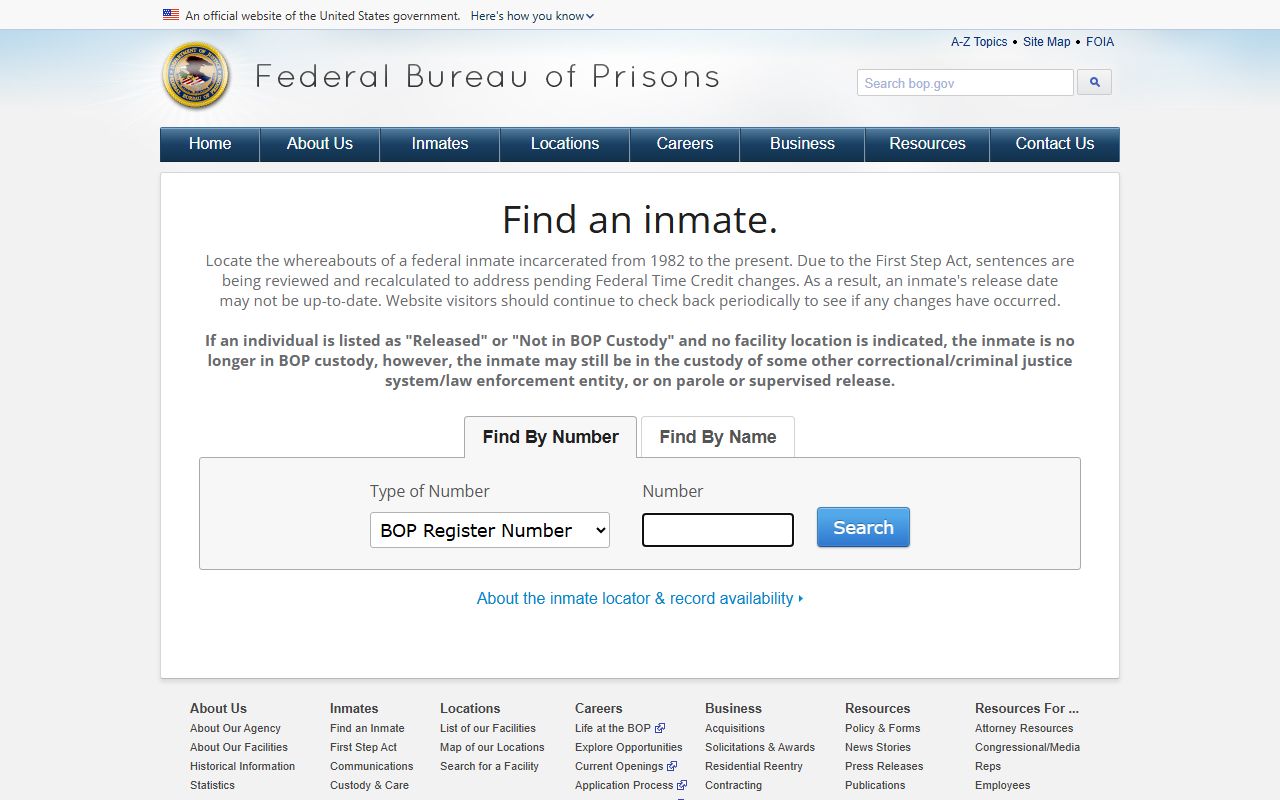
Federal custody is separate from Hawaii DCR custody and from state eCourt Kokua case searching.
ICE is separate again. The research identifies the ICE Online Detainee Locator System for current ICE custody and people in U.S. Customs and Border Protection custody for more than 48 hours. It cannot search records of persons under 18. ICE also lists Federal Detention Center Honolulu as a Hawaii detention facility. Immigration detention, immigration bond, and removal proceedings do not use DCR's jail or parole framework.
The bottom line is procedural: local police may hold the booking record, DCR may hold the custody record, the Hawaii Judiciary may hold the filed state court case, BOP or U.S. Marshals may hold federal custody information, and ICE may hold immigration detention information.